
✨ Introduction
Buddhism is one of the world’s major spiritual traditions, founded by Gautama Buddha (also known as Shakyamuni Buddha) in the 6th–5th century BCE in India.
At its core, Buddhism focuses on understanding suffering and attaining liberation through wisdom, ethical conduct, and mental discipline. The teachings of the Buddha are preserved in the Tripitaka (Three Baskets):
- Vinaya Pitaka – Monastic discipline
- Sutra Pitaka – Discourses of the Buddha
- Abhidharma Pitaka – Philosophical and analytical teachings
These teachings guide practitioners toward overcoming the three poisons:
- Desire
- Anger
- Ignorance
🏛️ Early Development of Buddhism in India
The historical evolution of Buddhism in India can be understood in four key phases:
1. 🧘 Early Buddhism (6th–5th Century BCE)
This phase marks the lifetime and teachings of Gautama Buddha and the preservation of his teachings by disciples.
- Focus on core teachings like the Four Noble Truths and Eightfold Path
- Establishment of the monastic community (Sangha)
- Oral transmission of teachings
2. 📚 Development of Schools (4th Century BCE – 1st Century CE)
After the Buddha’s passing (Mahaparinirvana), interpretations of his teachings led to the formation of different schools.
- Emergence of early Buddhist schools (often referred to as Theravāda traditions, instead of the older term “Hinayana”)
- Division into multiple sub-schools
- Emphasis on individual liberation (Arhat ideal)
- Development of detailed philosophical systems
3. 🌼 Rise of Mahayana Buddhism (1st – 7th Century CE)
This period saw the emergence of Mahayana Buddhism, which expanded the scope of Buddhist practice.
Key features:
- Ideal of the Bodhisattva (compassion for all beings)
- Development of philosophical schools like:
- Madhyamaka (Middle Way philosophy)
- Yogachara (Mind-only school)
Prominent scholars:
- Nagarjuna
- Asanga
- Vasubandhu
4. 🔮 Vajrayana / Tantric Buddhism (7th Century Onwards)
Later developments introduced esoteric practices known as Vajrayana Buddhism.
- Use of rituals, mantras, and meditation techniques
- Transmission through masters and lineages
- Influenced the spread of Buddhism to Tibet
Key figures:
- Padmasambhava
- Marpa Lotsawa
🌏 Spread of Buddhism Across Asia
Buddhism began expanding beyond India around the 3rd century BCE, adapting to different cultures.
Key Milestones:
- Sri Lanka (3rd century BCE) via Mahinda and Sanghamitta, supported by Ashoka
- China (2nd–3rd century CE)
- Southeast Asia (Myanmar, Thailand, Cambodia)
- Korea and Japan (4th–6th century CE)
- Tibet (7th–8th century CE)
👉 Buddhism adapted to local traditions, creating diverse forms across Asia.
📉 Decline of Buddhism in India
By the 12th–13th centuries CE, Buddhism had significantly declined in India.
Contributing factors:
- Gradual assimilation into evolving Hindu traditions
- Decline of monastic institutions
- Invasions that led to the destruction of major universities like Nalanda University
- Reduced royal patronage after the Gupta period
👉 The decline was complex and multi-causal, rather than due to a single factor.
🌱 Revival of Buddhism in Modern India
Buddhism has seen a revival in India in recent centuries:
- Spread of Theravāda Buddhism
- Growth of Tibetan Buddhism in regions like Ladakh and Himachal Pradesh
- Social and spiritual revival movements led by figures like B. R. Ambedkar
Today, India remains a major center for Buddhist pilgrimage, including sites like:
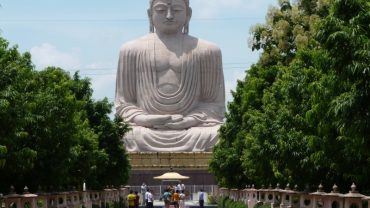
- Bodh Gaya (enlightenment site of Buddha)
- Sarnath (first sermon)
- Kushinagar (Mahaparinirvana site)
- Nalanda ( Anceant University )
- Vaishali ( Vaishali Stupa )
- Sravasti ( Maheth & Saheth )
- Rajgir ( Bamboo Garden , Vishwa Shanti Stupa )
🏁 Conclusion
Buddhism originated in India and grew into a global spiritual tradition influencing millions of people across Asia and beyond. While it declined in its homeland for centuries, it has re-emerged in modern India as both a spiritual path and cultural heritage.

Comment (0)